

September 29, 2026 •Network Solutions
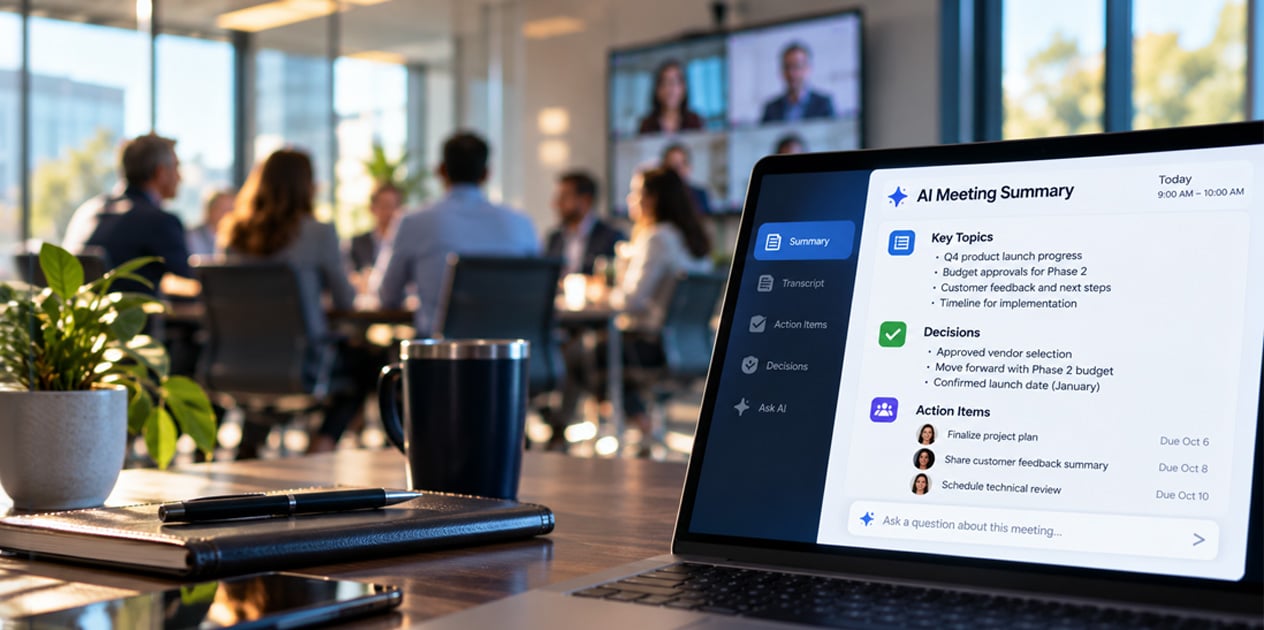
For years, the collaboration conversation focused on making meetings better.
Better cameras. Better microphones. Better conference rooms. Better video quality. Better ways for remote employees to participate. Organizations invested heavily in recreating the experience of sitting around the same table, even when the people involved were scattered across offices, homes and time zones.
Those investments mattered. But AI is beginning to change the question.
Instead of asking, “How do we make this meeting better?” organizations can increasingly ask, “Who actually needs to attend this meeting at all?”
That could have a much bigger impact on productivity.
Consider how many meetings people attend primarily because they are afraid of missing something.
Maybe there will be a decision that affects their project. Someone might assign them a task. A customer could raise an issue they need to know about. Or perhaps they simply need ten minutes of information buried somewhere inside a 60-minute meeting.
The safest option has traditionally been to attend.
Multiply that across an organization and the cost becomes significant. Employees spend hours listening for the small portion of a conversation that actually matters to them.
Recorded meetings helped, but they introduced another problem: somebody still had to watch the recording.
AI is beginning to remove that limitation.
A traditional meeting recording captures what happened.
AI-enabled collaboration platforms can increasingly help people understand what happened.
That distinction matters.
Transcription provides a searchable record of the conversation. AI can go further by summarizing discussions, identifying decisions, capturing action items and helping users find specific information without replaying an entire meeting.
Imagine returning from vacation and discovering that your team held six project meetings while you were gone.
The old options weren't particularly attractive. You could watch several hours of recordings, read through meeting notes of varying quality, or ask coworkers to catch you up.
Now the question can be much simpler:
What decisions were made while I was gone, and which ones affect me?
That begins to change the value of the meeting itself.
This can also help people who join meetings late.
Someone arriving 20 minutes into a meeting traditionally has two choices: interrupt the conversation and ask what they missed or spend the rest of the meeting trying to piece together the context.
AI-generated summaries can provide another option.
Participants can catch up on what has already been discussed and enter the conversation with greater context. Depending on the collaboration platform and capabilities available, users may also be able to ask questions about the discussion or review key points without interrupting everyone else.
That seems like a small improvement until you consider how often it happens across hundreds or thousands of employees.
Five minutes saved here. Twenty minutes there. One unnecessary meeting avoided entirely.
The cumulative impact can become meaningful.
There is another important change happening.
For most organizations, meetings have historically been temporary information.
People talk. Decisions are made. Tasks are assigned. Ideas are discussed. Then everyone leaves.
Unless someone takes good notes, much of that information disappears into people's memories.
AI-assisted collaboration can turn conversations into information that can be searched and referenced later.
What did the customer say about the implementation schedule?
Who agreed to contact the vendor?
What concerns did engineering raise?
What decision did we make about the rollout?
Instead of relying entirely on memory, handwritten notes or another meeting to answer those questions, organizations can begin treating conversations as part of their working knowledge.
That has implications far beyond meeting convenience.
The next step is connecting conversations to workflows.
If a meeting produces three action items, those actions shouldn't have to remain buried in a transcript. If someone makes a decision, that information should be available to the people and systems that need it.
This is where AI assistants and increasingly capable AI agents become especially interesting.
A collaboration platform can become part of the workflow surrounding the meeting: summarizing information, identifying follow-up work, helping draft communications and providing employees with context from conversations they couldn't attend.
Cisco is already building this direction into Webex through AI Assistant capabilities across meetings, messaging, calling and customer experience. Cisco has continued expanding those AI capabilities as part of its broader collaboration strategy. Cisco Blogs
The opportunity isn't simply to automate meeting notes. It's to reduce the administrative work created by meetings in the first place.
Organizations should probably resist the temptation to measure AI collaboration by how many AI features employees use.
A better measurement may be time.
Are people spending less time searching for information?
Can employees skip meetings where their participation isn't necessary?
Can someone quickly understand a discussion that happened while they were unavailable?
Are decisions and responsibilities clearer afterward?
Can employees spend more of their day doing the work the meeting was supposed to support?
Those are meaningful productivity outcomes.
And they point toward a different collaboration strategy: the best collaboration environment may be the one that requires less synchronous collaboration.
People should still meet when conversation, debate, creativity and human interaction matter. AI doesn't eliminate those things.
It can make it less necessary to put eight people on a calendar simply so nobody misses three minutes of relevant information.
Getting there requires more than enabling an AI feature.
Calling, meetings, messaging, contact center, identity, security, networking, devices and the user experience increasingly intersect. AI adds another layer that makes thoughtful design even more important.
That's where the experience of the technology partner matters.
Network Solutions has spent decades designing, deploying and supporting Cisco Collaboration environments. NSI achieved Cisco's Master Collaboration Specialization after demonstrating advanced technical capabilities and master-level processes through an intensive third-party audit focused on designing, deploying and supporting complex Cisco Collaboration solutions. NSI1
 Under today's Cisco 360 Partner Program, NSI has also achieved Cisco Preferred Collaboration Partner status. Cisco says Preferred Partners demonstrate advanced technical skills, deeper customer engagement, mature lifecycle and adoption practices, and the ability to deliver comprehensive solutions. For customers, the designation provides a current Cisco-validated indicator that a partner has invested in the expertise and practices needed to support the Collaboration portfolio beyond the initial technology purchase. Cisco Newsroom
The tools used to connect people are changing quickly. The objective hasn't changed nearly as much: help people communicate, make decisions and get work done with less friction.
If you're evaluating Webex, modernizing an existing collaboration environment, or exploring how AI can improve the way your teams communicate and work, complete the form below to start a conversation with Network Solutions.