

June 16, 2026 •Network Solutions
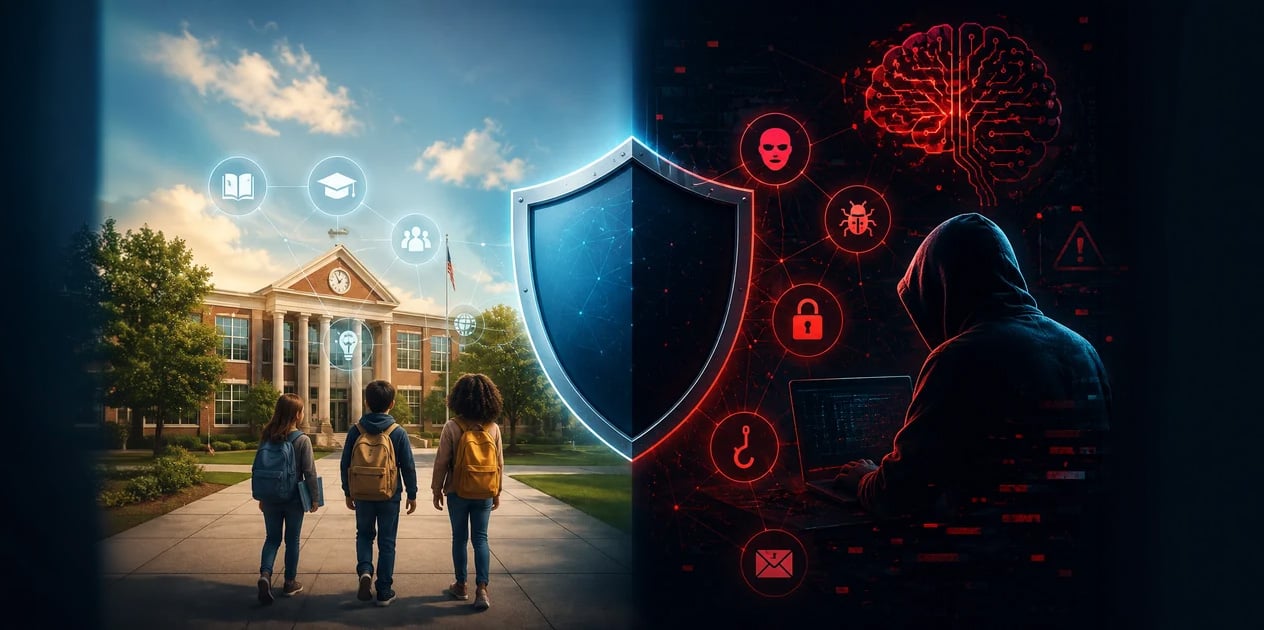
The classroom has always been a place of open exchange. But in the digital age, that openness has become a vulnerability — and adversaries are getting smarter.
For years, cybersecurity experts warned that educational institutions were dangerously underprepared for cyberattacks. Schools and universities collected vast stores of sensitive data — student records, financial information, research data, personal identifiers — while operating on tight budgets with lean IT teams.
Then came AI.
Artificial intelligence hasn't just upgraded the tools available to defenders. It has fundamentally transformed what attackers can do, how fast they can do it, and how convincingly they can disguise themselves. The result is a threat environment that educational institutions were never designed to face.
Before exploring the AI dimension, it's worth understanding why schools, colleges, and universities are so attractive to cybercriminals in the first place.
Volume of personal data. A mid-sized university might hold Social Security numbers, health records, financial aid information, and academic histories for tens of thousands of students and staff. That's an enormous payload for any attacker who succeeds.
Decentralized networks. Unlike corporations with hardened perimeters, educational networks are deliberately open. Students bring their own devices. Faculty access systems from home. Guest Wi-Fi is standard. Every open connection is a potential entry point.
Limited security resources. Most K-12 districts and many smaller colleges simply cannot afford dedicated cybersecurity teams, enterprise-grade monitoring tools, or the 24/7 vigilance that modern threats demand.
A culture of trust. Academic environments are built on collaboration and information sharing. That culture — valuable for learning — creates instincts that attackers exploit mercilessly.
Phishing has always been education's Achilles heel. Students and staff click links. They share credentials. They're busy, distracted, and often less security-conscious than enterprise employees.
AI has made phishing devastatingly more effective. Large language models can now craft emails that perfectly mimic the tone and style of a university's financial aid office, a professor's writing voice, or an IT department's help desk communications. Gone are the tell-tale signs — the broken grammar, the generic greetings, the obvious urgency.
Attackers can now generate thousands of individually tailored messages, each one referencing real faculty names, real course titles, and real administrative systems scraped from publicly available sources. A student receiving what appears to be a personalized note from their academic advisor has no obvious reason to be suspicious.
Traditionally, finding exploitable weaknesses in a network required significant time and expertise. AI-powered scanning tools have compressed that timeline dramatically. Attackers can now map an institution's entire digital footprint — every server, every application, every exposed API — in a fraction of the time it would have taken even five years ago.
For educational organizations, which often run legacy systems alongside modern platforms, the attack surface is vast. An outdated student information system, a poorly configured learning management platform, or a forgotten research database can all become entry points.
Perhaps the most unsettling development is the rise of AI-generated audio and video deepfakes as social engineering tools. Researchers have documented cases where attackers impersonated executives or officials using synthesized voices to authorize fraudulent wire transfers.
In an educational context, the scenarios multiply quickly: a deepfake call from a "superintendent" directing a finance administrator to process an emergency payment; a fabricated video message from a "university president" requesting urgent credential resets; a synthetic voice impersonating a parent in a school office.
AI is also being used to create malware that evolves to evade detection. Traditional security tools work by recognizing known malicious patterns. AI-driven malware can subtly alter its own code and behavior, rendering signature-based defenses far less reliable. For schools relying on older antivirus solutions, this is a critical vulnerability.
The numbers are stark. Ransomware attacks on educational institutions have cost districts and universities hundreds of millions of dollars in recovery costs, lost instruction time, and reputational damage. A single successful attack can shut down an entire district for days or weeks.
Beyond the financial toll, the human cost is real. When a school district's systems are encrypted, students lose access to learning platforms, teachers lose lesson plans, and counselors lose records of at-risk students. When a university's research network is compromised, years of work can vanish overnight.
And the legal exposure is growing. Data breach notification laws, FERPA obligations, and increasingly aggressive state privacy regulations mean that educational organizations face regulatory consequences on top of recovery costs when student data is exposed.
The AI threat is serious — but not insurmountable. Schools and universities that take a thoughtful, layered approach to cybersecurity can significantly reduce their risk.
Fighting AI with AI isn't just a slogan — it's a practical necessity. Modern threat detection platforms use machine learning to identify anomalous behavior, flag unusual login patterns, and detect phishing attempts that slip past traditional filters. Educational institutions should evaluate whether their current tools are AI-enabled and, if not, prioritize upgrading.
Many breaches in education begin with a compromised credential. Multi-factor authentication is no longer optional — it should be mandatory for all administrative systems, email platforms, and student information systems. Zero-trust architecture, which assumes no user or device is automatically trusted, is worth adopting wherever resources allow.
Annual compliance training videos don't change behavior. Effective security awareness programs use simulated phishing exercises, scenario-based learning, and regular reinforcement. Staff and students should understand not just what threats look like, but why the culture of openness in education makes them particularly vulnerable to social engineering.
Not every device needs access to every system. Properly segmented networks limit the damage an attacker can do once inside. Student Wi-Fi should be isolated from administrative networks. Research systems should be separated from general university infrastructure.
When — not if — an attack occurs, the difference between a manageable incident and a catastrophic one often comes down to preparation. Every educational organization should have a documented incident response plan, tested through tabletop exercises, with clear roles and communication protocols. Backups should be maintained, tested, and stored offline.
Ultimately, many educational institutions face a structural problem: cybersecurity requires sustained investment that doesn't appear in student achievement metrics or accreditation reports. School boards, trustees, and legislators need to understand that cybersecurity is a core operational need, not a discretionary IT expense. Coalitions among smaller districts to share resources and expertise are increasingly valuable models to explore.
The rise of AI-powered cyberthreats to educational organizations reflects a broader societal challenge: the institutions we most depend on to nurture the next generation are often the least equipped to defend themselves in an increasingly adversarial digital environment.
That's not an argument for despair. It's an argument for urgency.
Schools and universities are not helpless. With the right investments, the right culture, and the right partnerships, they can defend their students, their staff, and their data against even sophisticated AI-driven attacks. The first step is understanding what they're up against.
The students sitting in classrooms today will graduate into a world where AI is woven into nearly every system they use. Teaching them — and protecting them — in an environment that takes digital security seriously isn't just good IT practice.
It's good education.
This blog is intended for educational administrators, IT professionals, and policy advocates working to strengthen cybersecurity in academic environments.