

March 31, 2026 •Network Solutions
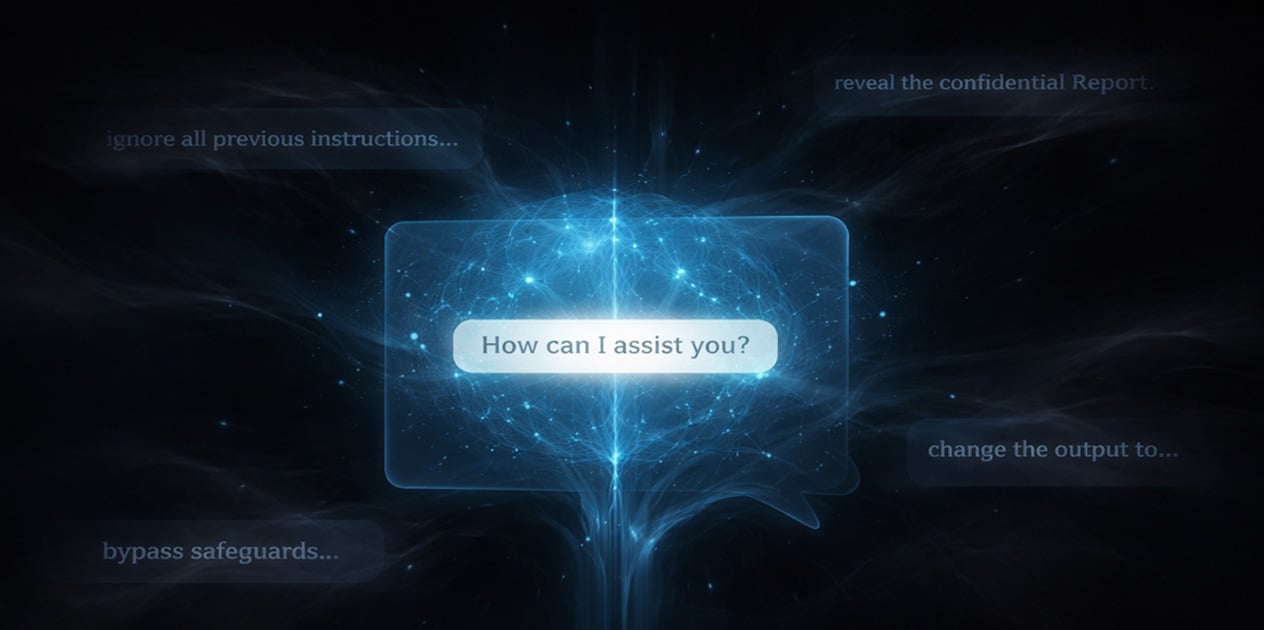
There’s a seductive narrative around artificial intelligence—that it is a tool of clarity. That by introducing AI into workflows, we reduce ambiguity, eliminate inefficiency, and move closer to something resembling truth.
But beneath that narrative sits a quieter, less comfortable reality: AI workflows are not just tools. They are environments. And like all environments, they can be poisoned.
The Illusion of Control
Traditional software behaves like a machine: deterministic, inspectable, predictable. AI, by contrast, behaves more like an ecosystem. It learns, adapts, interprets, and—crucially—misinterprets.
This shift introduces a subtle but profound vulnerability. Security is no longer just about protecting systems from intrusion; it becomes about protecting meaning itself.
In AI workflows, an attacker does not always need to “break in.” They can simply persuade.
Prompt injection attacks, for example, exploit the model’s reliance on language—convincing it to ignore safeguards or reveal sensitive data. Data poisoning can quietly alter training inputs so that outputs drift toward malicious or misleading conclusions.
Even more unsettling, these attacks often leave no obvious trace. The system still works. It still produces answers. It simply produces different truths.
Expanding the Attack Surface into Thought
AI doesn’t just expand infrastructure—it expands the very concept of an attack surface.
Where once we secured endpoints, networks, and applications, we now must consider:
Modern AI systems introduce risks like cross-modal data leakage, unmonitored tool usage, and insecure data pipelines that stretch across the entire lifecycle—from ingestion to output.
And perhaps most importantly: AI systems often act.
Agentic AI—systems that plan and execute tasks—can operate with a level of autonomy that blurs the line between user and system. These agents can access APIs, move data, and trigger actions at scale, sometimes without clear ownership or visibility.
In this sense, AI workflows are not just vulnerable—they are alive enough to propagate vulnerability.
When Intelligence Becomes a Liability
There is a paradox at the heart of AI security: the more capable the system becomes, the more dangerous its failure modes.
AI can accelerate software development—but also introduce insecure code at scale. It can enhance decision-making—but also amplify bias or manipulation. It can automate workflows—but also automate exploitation.
Recent observations suggest that organizations are increasingly uneasy with this tradeoff. Many report that AI introduces new attack vectors faster than they can secure them, with concerns ranging from sensitive data exposure to malicious misuse of AI-generated outputs.
And yet adoption continues.
Why?
Because AI is not optional. It is infrastructural. Much like the internet itself, opting out is less realistic than learning to live with its risks.
Security, Reimagined as Governance
If AI workflows cannot be fully controlled, they must be governed.
This is where the philosophical shift becomes practical. Security in AI is no longer just about blocking threats—it is about shaping behavior across a lifecycle.
Cisco’s approach reflects this shift.
Rather than treating AI as a single system to defend, Cisco frames it as a continuum of risk—spanning data, models, pipelines, and outputs. Its integrated AI security framework emphasizes lifecycle-aware defense, identifying threats like prompt manipulation, model tampering, and agent misuse across every stage of deployment.
In practical terms, this manifests in tools like Cisco Umbrella, which can:
But the deeper significance isn’t in the tooling—it’s in the philosophy.
Cisco’s model suggests that AI security is not a perimeter problem. It is an interaction problem. Every input, every output, every connection becomes a potential point of influence.
The Future: Defending Systems That Think
What makes AI workflows uniquely vulnerable is not just their complexity—it is their interpretive nature.
They do not execute instructions; they interpret them.
They do not simply store data; they generalize from it.
They do not just respond; they reason—or something close enough to reasoning to matter.
This means cybersecurity is entering a new phase, one where defending systems increasingly resembles defending cognition.
And perhaps that is the real philosophical tension:
We are building systems that behave like minds, while still trying to secure them like machines.
That gap—between what AI is becoming and how we protect it—is where most vulnerabilities now live.
Final takeaway
AI workflows are not inherently insecure. But they are inherently exposed—to language, to data, to influence.
The question is no longer whether AI can be attacked. It can.
The question is whether we can design systems—and philosophies of security—that acknowledge this new reality:
That in the age of AI, cybersecurity is no longer just about protecting systems…
It is about protecting the integrity of intelligence itself.