
Cisco Access Manager vs. Cisco Identity Services Engine (ISE): Architectural Trade-offs and Use Case Alignment
March 24, 2026 •Jason Dell
Identity-driven access control is no longer optional—it’s a foundational requirement for securing modern networks. As organizations move toward zero-trust models, the ability to enforce policy based on user and device identity has become critical.
Cisco addresses this need with two distinct solutions: Cisco Access Manager (CAM) and Cisco Identity Services Engine (ISE). While both platforms deliver identity-based access control, they are built for very different operational models. Understanding those differences is key to selecting the right solution.
Two Platforms, Two Philosophies
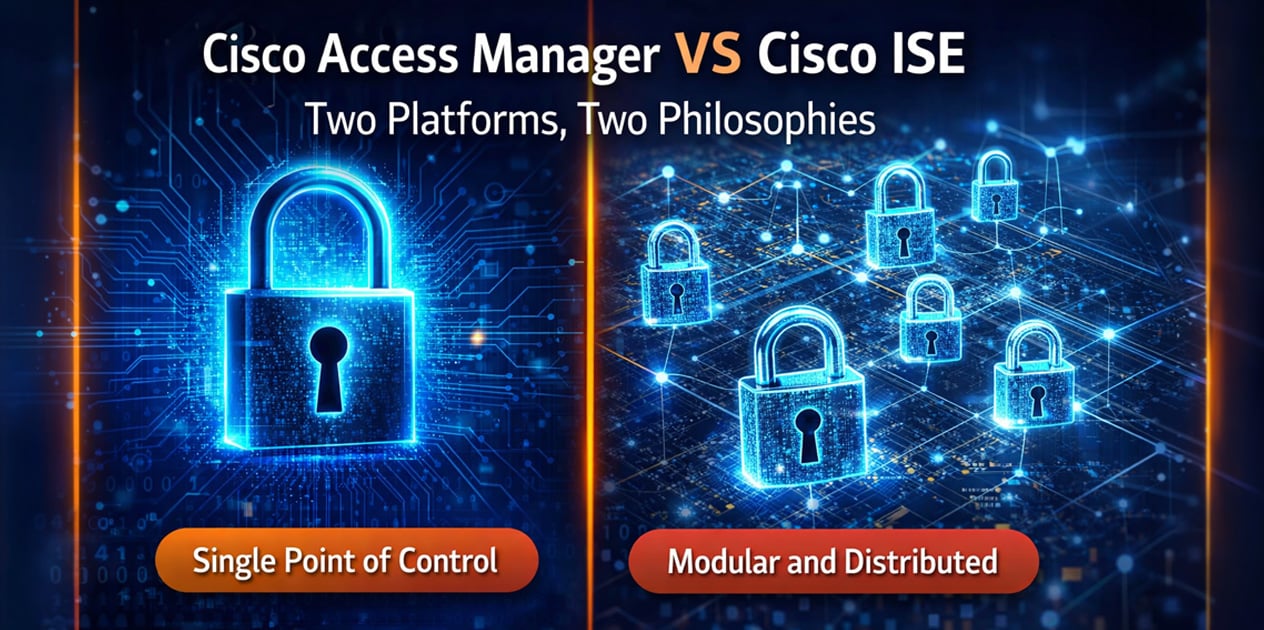
At a high level, the distinction between Access Manager and ISE is not simply about features—it’s about intent.
- Cisco Access Manager is a cloud-delivered, simplified NAC solution designed for speed, ease of deployment, and minimal operational overhead.
- Cisco ISE is a full-featured policy platform built for deep customization, large-scale environments, and complex security ecosystems.
Rather than competing directly, these platforms serve different tiers of network maturity and operational capability.
Cisco Access Manager (CAM)
A Cloud-Native Approach to NAC
Cisco Access Manager is delivered as a SaaS application within the Meraki dashboard. This architecture eliminates the need for dedicated NAC infrastructure, shifting policy control, identity integration, and enforcement into a centralized cloud-managed plane.
The result is a dramatically simplified deployment model—no appliances, no sizing exercises, and no infrastructure lifecycle to manage.
Where Access Manager Fits Best
Access Manager is particularly well-suited for organizations that prioritize simplicity and speed over deep customization. It aligns well with:
- Meraki-centric environments (wireless, switching, edge)
- Distributed organizations that benefit from centralized cloud control
- Teams with limited network or security engineering resources
- Environments that need baseline zero-trust enforcement without heavy complexity
Core Capabilities
Access Manager focuses on delivering essential identity-based access control without unnecessary overhead:
- Identity-based policy enforcement using user and device context
- Simplified onboarding workflows for users and endpoints
- Native cloud management through a single dashboard
- Integrated segmentation to limit lateral movement within the network
Operational Impact
The biggest advantage of Access Manager is operational efficiency.
Organizations can move from no NAC to enforced identity policies quickly, without the traditional burden of infrastructure deployment. There’s no patching, upgrading, or scaling to worry about, and the need for specialized NAC expertise is significantly reduced.
Limitations to Consider
That simplicity comes with tradeoffs:
- Limited support outside of Meraki environments
- Less flexibility for highly granular or conditional policies
- Fewer integrations with third-party security tools
Access Manager is intentionally streamlined—it solves common problems well but does not aim to cover every edge case.
Cisco Identity Services Engine (ISE)
A Comprehensive Policy Control Platform
Cisco ISE takes a very different approach. It is deployed on-premises or in virtual environments and acts as a centralized authority for authentication, authorization, and accounting (AAA). Beyond that, it provides device profiling, posture assessment, and advanced segmentation capabilities.
ISE is designed for environments where control, visibility, and integration depth are critical.
Where ISE Excels
ISE is built for organizations with complex requirements, including:
- Large-scale enterprise networks
- Multi-vendor infrastructure environments
- Regulatory or compliance-driven security models
- Advanced segmentation and policy customization needs
- Security architectures requiring deep integration across platforms
Core Capabilities
ISE’s strength lies in its depth and flexibility:
- Advanced policy framework
- Multi-attribute evaluation (user, device, location, posture)
- Complex conditional logic and hierarchical policies
- Device profiling and classification
- Automated identification of endpoints, including IoT and OT
- Posture assessment
- Validation of endpoint compliance (patching, AV status, configuration)
- Scalable segmentation with TrustSec
- Security Group Tags (SGTs) to enforce policy independent of IP addressing
- Ecosystem integration via pxGrid
- Bi-directional integration with SIEM, EDR/XDR, firewalls, and other tools
Operational Impact
ISE enables a much higher level of control and visibility:
- Fine-grained access policies aligned with business and security requirements
- Deep insight into users, devices, and their security posture
- Coordinated response across the broader security ecosystem
- Strong support for compliance and regulatory enforcement
Tradeoffs
That power comes at a cost:
- Significant design and deployment effort
- Ongoing operational management requirements
- Dependence on specialized expertise
- Responsibility for infrastructure lifecycle (scaling, patching, redundancy)
ISE is not a “set it and forget it” solution—it’s a strategic platform that requires investment.
Comparative Summary
| Dimension | Access Manager | ISE |
|---|---|---|
| Deployment Model | SaaS (Meraki cloud) | On-prem / virtualized |
| Implementation Time | Short | Moderate to long |
| Policy Complexity | Moderate | High |
| Infrastructure Overhead | Minimal | Significant |
| Ecosystem Integration | Limited | Extensive |
| Network Compatibility | Primarily Meraki | Multi-vendor |
| Operational Skill Requirement | Low | High |
Choosing the Right Platform
The decision between Access Manager and ISE should be driven by operational needs—not just feature comparison.
Access Manager is the better fit when:
- Rapid deployment and simplicity are top priorities
- The network is largely Meraki-based
- Policy requirements are well-defined but not highly complex
- There is limited capacity for dedicated NAC administration
ISE is the better fit when:
- Fine-grained, highly customized policy control is required
- Broad integration across the security ecosystem is necessary
- The environment includes diverse infrastructure and endpoint types
- The organization can support ongoing engineering and operational investment
Final Perspective
Cisco Access Manager and Cisco ISE are not interchangeable—they represent two different design philosophies.
- Access Manager emphasizes speed, simplicity, and operational efficiency
- ISE emphasizes control, extensibility, and depth
The right choice comes down to alignment: matching the platform’s strengths to your organization’s technical requirements and operational capacity.
Network Solutions, Inc. (NSI), founded in 1989 is a Managed Services and Cisco Gold Provider demonstrating advanced competencies across Cisco's solutions, including networking, security, collaboration, and data center technologies. This designation reflects NSI's commitment to delivering reliable, high-quality services backed by Cisco’s latest technology and best practices, ensuring that customers receive expert guidance and support for their implementations.
To learn more about Network Solutions or our NSI ADVANCE Managed Services, including
- Secure Network (managed network)
- Secure User (managed security)
- Managed Cisco XDR (Extended Detection and Response)
- Everyone Connected (managed collaboration)
Schedule to security platform and security strategy is best for your organization.
Call 888.247.0900 or fill out this form to get started.
Get Updates
Featured Articles
Categories
- AI (20)
- Automated Technology (11)
- backup (1)
- CAM (1)
- Cisco (34)
- Cisco Live Update (1)
- Cisco News (2)
- Cisco UCS (1)
- Cloud Networking (6)
- Collaboration (26)
- compute (1)
- CyberSecurity (37)
- Data Center (35)
- Defense (1)
- DevOps (3)
- DisasterRecovery (1)
- DNA (2)
- Education (3)
- Encryption (1)
- Enterprise Networking (38)
- Full-Stack (1)
- Future (1)
- healthcare (2)
- hybrid cloud (1)
- Hybrid Cloud Strategy (1)
- Hyperconverged Infrastructure (2)
- Infrastructure Cost Optimization (1)
- Innovation (1)
- Innovative Technology (12)
- Internet of Things (2)
- IoT (2)
- Managed Services (11)
- Manufacturing (1)
- Modern Data Center (2)
- Monitoring (3)
- Network Management (6)
- Networking (3)
- NSI (1)
- nutanix (1)
- Observability (1)
- OT (1)
- Ransomware (2)
- SchoolTechnology (6)
- SD-WAN (1)
- SDN (1)
- securit (1)
- Security (80)
- security management (8)
- security strategy (10)
- Software Defined Network (1)
- SSE (2)
- sustainability (1)
- Telehealth (4)
- Telemedicine (1)
- veeam (1)
- Video (1)
- videoconferencing (1)
- Virtualization (2)
- VMware to Nutanix (2)
- webex (3)
- wifi (2)
- XDR (1)
- Zero Trust (10)
