

April 21, 2026 •Network Solutions
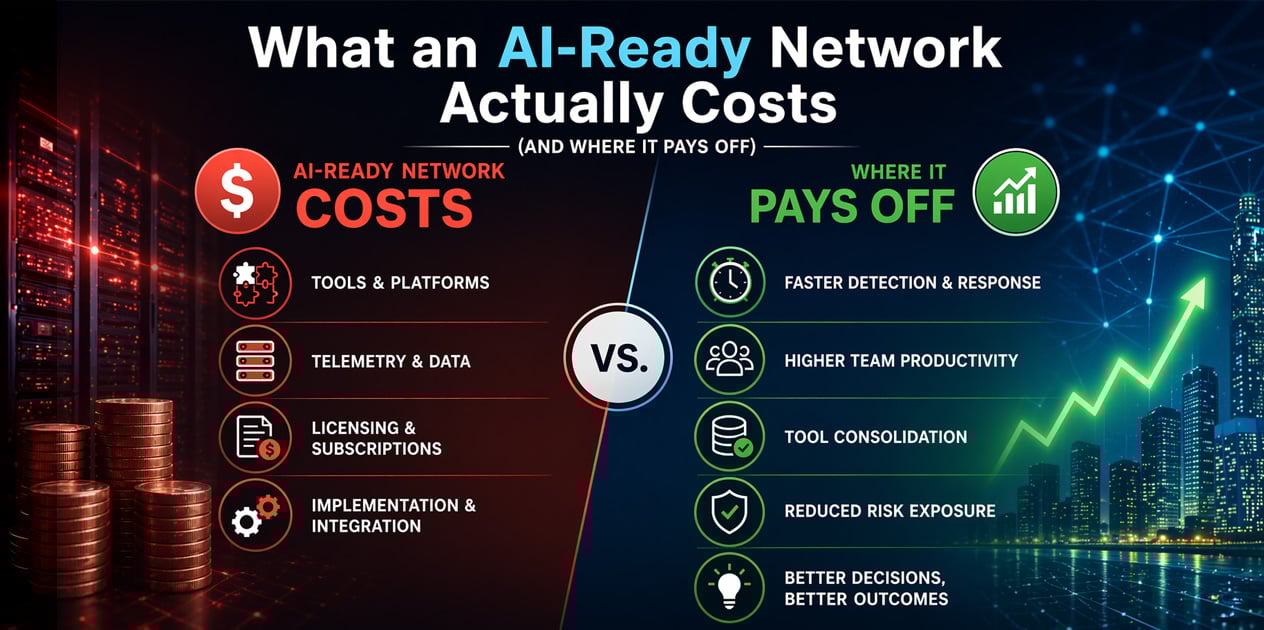
There’s no shortage of messaging around “AI-ready infrastructure.”
But most of it skips the part buyers actually care about:
What does this cost—and what do we get back?
If you’re evaluating upgrades to your network or security architecture in 2026, you’re likely being asked to justify investments in:
This post breaks that down in practical terms—where the money goes, and where it realistically comes back.
Where the Costs Actually Show Up
An “AI-ready network” isn’t one purchase. It’s a shift across multiple layers.
1) Tool Consolidation (and Expansion at the Same Time)
At first glance, it looks like you’re buying more:
But in most environments, these replace a mix of:
Net effect:
You often reduce total tool count, but increase spend on fewer, more capable platforms.
2) Infrastructure and Telemetry Overhead
AI systems need data—lots of it.
That typically means:
This is one of the more underestimated costs.
Not because it’s massive—but because it’s persistent and growing.
3) Licensing Model Shifts (CapEx → OpEx)
Most modern platforms are subscription-based.
That changes the conversation from:
This matters internally. It affects:
4) Implementation and Integration
This is where projects either succeed or quietly stall.
Costs here include:
Reality check:
The more “integrated” the platform, the more important this phase becomes.
Where the Payoff Actually Happens
Now the important part—because this is where many business cases fall apart if you don’t quantify it properly.
1) Reduced Time to Detect and Resolve Issues
This is the most immediate return.
With better telemetry and AI-assisted analysis:
That translates directly into:
What this means financially:
Downtime is expensive—even small reductions have outsized impact.
2) Fewer Manual Hours (and Less Burnout)
Most network and security teams are already stretched.
AI-driven operations reduce:
This doesn’t usually eliminate headcount—but it changes how teams spend time:
Practical outcome:
You delay or avoid hiring additional staff while improving output.
3) Tool and Vendor Rationalization
Many environments accumulate tools over time:
AI-ready platforms often consolidate these functions.
Result:
The savings aren’t always dramatic—but the operational simplification is.
4) Reduced Risk Exposure
This is harder to quantify—but it’s real.
Better visibility + faster response leads to:
From a financial perspective, this affects:
Even a single avoided or contained incident can justify a large portion of the investment.
5) Better Decision-Making (Often Overlooked)
This is the quiet payoff.
When you have consistent, high-quality data across your environment:
Over time, this reduces waste in areas that don’t always show up in initial ROI models.
Where Organizations Miscalculate
This is where I’d challenge most assumptions.
Mistake 1: Treating AI as an Add-On
If you layer AI tools on top of a fragmented environment, you don’t get the benefit.
You get:
The value comes from integration—not addition.
Mistake 2: Ignoring Operational Readiness
Technology doesn’t fix unclear processes.
If you don’t define:
You won’t see meaningful improvements in MTTR—even with better tools.
Mistake 3: Overestimating Immediate ROI
Some returns are quick (like faster troubleshooting).
Others take time:
A realistic model includes both short-term gains and longer-term efficiency improvements.
A Simple Way to Frame the Business Case
Instead of trying to justify everything at once, break it into three buckets:
1) Immediate Impact (0–6 months)
2) Operational Efficiency (6–18 months)
3) Strategic Value (18+ months)
The Bottom Line
An AI-ready network isn’t cheap.
But it’s also not just another layer of cost.
The organizations seeing the most value aren’t the ones buying the most tools—they’re the ones:
If you evaluate it purely as a technology upgrade, the numbers can be hard to justify.
If you evaluate it as an operational shift, the return becomes much clearer.
Making the shift to an AI-ready network is ultimately less about buying technology and more about aligning infrastructure, operations, and outcomes in a way that drives measurable business value. That’s where Network Solutions Inc. (NSI) comes in.
We help organizations cut through the noise—assessing where you are today, identifying the gaps that actually matter, and designing integrated architectures that deliver both immediate impact and long-term return.
Whether you’re just starting to evaluate AIOps or looking to rationalize an already complex environment, our team brings the expertise to turn strategy into execution without unnecessary cost or disruption. If you’re ready to understand what an AI-ready network would look like in your environment—and what it would realistically cost and return—fill out the form below to start the conversation with our experts.