
Quishing: The Hidden Risk Behind Convenient QR Codes
April 28, 2026 •Jason Dell
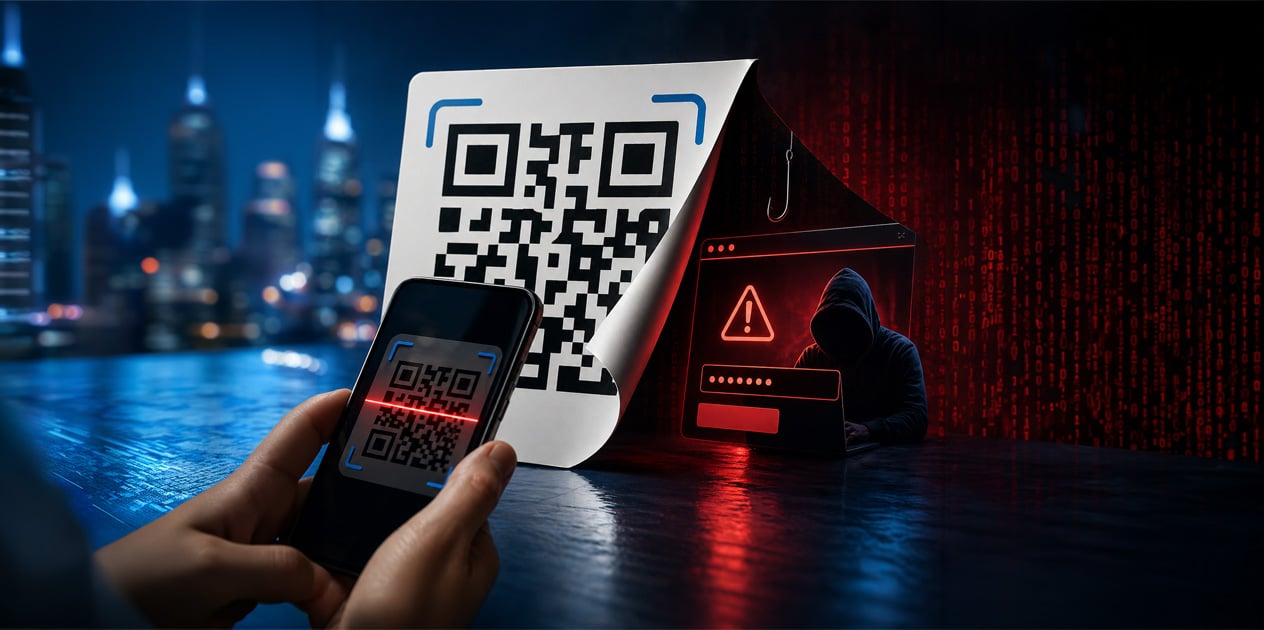
Quick Response (QR) codes have become a routine part of daily life. They are used for payments, menus, authentication, promotions, and more. Their convenience is undeniable: point your phone, scan, and you are instantly directed to content. However, this same simplicity introduces a growing cybersecurity threat known as quishing.
What Is Quishing?
Quishing (QR phishing) is a social engineering attack that uses QR codes to direct users to malicious destinations. Instead of clicking a suspicious email link, the victim scans a QR code—often trusting it implicitly—and is redirected to a fraudulent website or payload.
From a technical standpoint, a QR code is simply a machine-readable encoding of data, most commonly a URL. It has no inherent intelligence or security properties. It does not validate the destination, assess risk, or provide context.
The Core Problem: Blind Trust in QR Codes
A QR code does one thing: it points your device to a destination, typically a website. It does not:
- Verify whether the destination is legitimate
- Provide visibility into the full URL before navigation (in many cases)
- Assess the reputation or safety of the site
When you scan a QR code, you do not know where it leads unless you explicitly inspect the decoded URL—and many users do not.
When You Can Likely Trust a QR Code
QR codes are not inherently dangerous. In many cases, they are used safely and appropriately. The key difference is context and control.
You can generally have higher confidence in a QR code when:
- It is presented in a controlled, staffed environment
Example: trade shows, conferences, vendor booths, or in-person demos where representatives are present and accountable. - It is tied to a known, trusted brand interaction
Example: scanning a code directly from a company’s official website, app, or verified email. - You can verify the source physically and visually
Example: printed materials handed to you directly, not something publicly exposed and unattended. - The interaction is low-risk
Example: accessing general information, brochures, or event schedules—not entering credentials or payment details.
In these scenarios, there is still some risk—but it is significantly lower because the opportunity for anonymous tampering is reduced.
When QR Codes Are High Risk
Risk increases dramatically when QR codes are:
- Unattended and publicly accessible
Gas pumps, parking meters, posters, public bulletin boards - Easily replaceable or tampered with
Stickers placed over legitimate codes - Anonymous or lacking clear ownership
No branding, no context, no indication of who created it - Prompting sensitive actions
Login pages, payments, downloads, or account verification
The rule of thumb:
If anyone could have placed or modified the QR code without being noticed, treat it as untrusted.
What Can Happen?
Once redirected to a malicious site, several attack vectors become possible:
- Credential harvesting
- Payment fraud
- Malware delivery
- Session hijacking
- Data exfiltration
Mobile devices amplify this risk due to smaller screens and reduced visibility into URLs and security indicators.
A Realistic Attack Scenario: Gas Station QR Code Tampering
Consider a gas station pump displaying a QR code for payment or rewards. An attacker places a malicious sticker over the legitimate code. The replacement looks convincing.
A user scans it expecting a routine transaction and is redirected to a fraudulent site that mimics a legitimate service and captures sensitive information.
Because the context feels normal, the user is less likely to question it—making the attack highly effective.
Why This Works
Quishing succeeds because of:
- Implicit trust in QR codes
- Lack of visibility into destinations
- Mobile UX limitations
- Environmental legitimacy
Unlike email phishing, QR codes often bypass user skepticism.
Risk Mitigation Strategies
For Individuals
- Treat QR codes like unknown links—not inherently safe
- Preview and inspect the URL before proceeding
- Prefer manually navigating to known websites for sensitive actions
- Be cautious with public, unattended QR codes
- Use security-aware QR scanning tools when possible
- Keep devices updated
For Organizations
- Avoid relying on QR codes for sensitive workflows
- Use tamper-resistant designs or digital alternatives
- Educate users on QR risks and safe usage
- Monitor for impersonation domains
Conclusion
QR codes are not inherently malicious—but they are inherently opaque. They hide the destination and place the burden of trust on the user.
The real risk is not the technology itself—it is where the QR code comes from and whether that source can be trusted.
A simple principle applies:
A QR code is just a link you cannot see. Trust it only when you trust who put it there.
Take control of your cybersecurity with Network Solutions, Inc. (NSI) and Cisco’s industry-leading security solutions. Don’t let cyber threats compromise your business—partner with NSI to build a unified, AI-driven cybersecurity strategy that simplifies protection and ensures peace of mind. Schedule a free consultation today to assess your security gaps and start your journey toward a secure digital future.
If you're ready to discuss your business technology strategy with Network Solutions, fill out the form below to book a conversation!
Get Updates
Featured Articles
Categories
- AI (22)
- Automated Technology (12)
- backup (1)
- CAM (1)
- Cisco (34)
- Cisco Live Update (1)
- Cisco News (2)
- Cisco UCS (1)
- Cloud Networking (6)
- Collaboration (26)
- compute (1)
- CyberSecurity (37)
- Data Center (36)
- Defense (1)
- DevOps (3)
- DisasterRecovery (1)
- DNA (2)
- Education (3)
- Encryption (1)
- Enterprise Networking (39)
- Full-Stack (1)
- Future (1)
- healthcare (2)
- hybrid cloud (1)
- Hybrid Cloud Strategy (1)
- Hyperconverged Infrastructure (2)
- Infrastructure Cost Optimization (1)
- Innovation (1)
- Innovative Technology (12)
- Internet of Things (2)
- IoT (2)
- Managed Services (11)
- Manufacturing (1)
- Modern Data Center (2)
- Monitoring (3)
- Network Management (6)
- Networking (3)
- NSI (1)
- nutanix (1)
- Observability (2)
- OT (1)
- Ransomware (2)
- SchoolTechnology (6)
- SD-WAN (1)
- SDN (1)
- securit (1)
- Security (83)
- security management (11)
- security strategy (10)
- SmartHome (1)
- Software Defined Network (1)
- SSE (2)
- sustainability (1)
- Technology (1)
- Telehealth (4)
- Telemedicine (1)
- veeam (1)
- Video (1)
- videoconferencing (1)
- Virtualization (2)
- VMware to Nutanix (2)
- webex (3)
- wifi (2)
- XDR (1)
- Zero Trust (10)
