

April 14, 2026 •Jason Dell
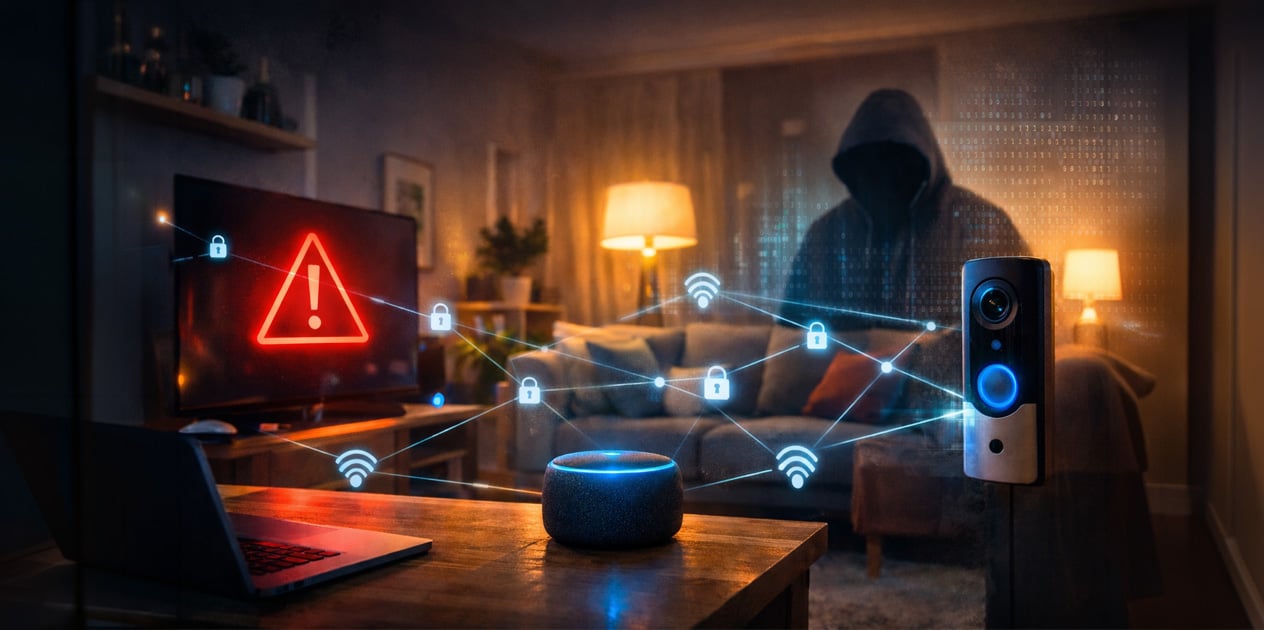
The modern home is increasingly saturated with “smart” devices. What started with a single smart thermostat or voice assistant has grown into an ecosystem: smart TVs, streaming sticks, doorbells, cameras, light bulbs, plugs, refrigerators, speakers, and even smart washers and ovens. Convenience has scaled rapidly—but so has the attack surface.
The Expanding Risk Surface of Smart Devices
Every additional connected device introduces another potential entry point into your home network. Unlike traditional computing devices, many of these products are designed to be always-on, always-connected, and rarely maintained by the end user. That combination—persistent connectivity with minimal oversight—makes them attractive targets.
Every smart device communicates over your network and, in many cases, out to the internet. The more devices you have, the more pathways exist for potential compromise.
Smart Devices Are Just Computers
At a technical level, smart devices are not fundamentally different from laptops or desktops. They run operating systems—often Linux-based kernels or embedded variants—and execute software that can contain vulnerabilities.
This means:
The difference is not capability—it’s maintenance and visibility. You likely update your laptop regularly and run endpoint protection. Your smart TV? Probably not.
The Security Tradeoff: Functionality vs. Protection
Manufacturers of smart devices often prioritize usability, cost, and feature delivery over robust security design. Rapid time-to-market and competitive feature sets tend to outweigh long-term patching strategies or hardened network behavior.
Common issues include:
Because of this, it’s prudent to assume that any given smart device may eventually become vulnerable—even if it isn’t today.
The Case for Network Isolation
This is where network segmentation becomes critical.
An isolated network for smart devices—sometimes called an IoT network—places all of these devices on a separate logical network (SSID or VLAN) that is segregated from your primary network where your laptops, desktops, and sensitive data reside.
Taking it a step further, a properly configured network can also enforce client isolation, meaning:
This drastically reduces lateral movement. If one device is compromised, it cannot be used to pivot into other devices or your primary systems.
Why Most Smart Devices Don’t Need Local Access
High-quality smart devices typically only require:
They generally do not need:
If a device requires broad local network access to function, that’s often a design compromise—not a necessity.
The Exception: Casting and Local Features
Some features do rely on local network communication. For example:
These protocols require your phone or computer to discover and communicate directly with devices like smart TVs.
To enable this, users often place smart TVs on their primary (non-guest) network. This convenience comes with tradeoffs:
A more secure approach is to selectively enable these features only when needed, or use network configurations that allow controlled cross-network communication rather than full access.
Consumer Routers Already Support This
The good news: many consumer-grade routers already support some form of isolation, even if it’s not marketed as such.
Look for features like:
A typical setup might include:
Summary
Smart devices are convenient, but they are also full-fledged computers with real vulnerabilities. Because manufacturers often prioritize functionality over security, it’s risky to treat them as inherently trustworthy.
Isolating these devices on a dedicated network—and ideally preventing them from communicating with each other—significantly reduces your exposure. Most smart devices only need internet access, not local network visibility, making isolation both practical and effective.
A small amount of network segmentation can go a long way in protecting your core devices and data in your home.
Network Solutions, Inc. (NSI) is a Midwest-based IT solutions provider and business technology integrator that helps organizations design, implement, and manage secure, high-performing network and application environments. Through a Cisco-focused partnership and decades of expertise, NSI delivers services in networking, security, collaboration, and data center solutions. NSI focuses on improving reliability, performance, and access for business systems, enabling clients to reduce operational complexity and better achieve strategic goals with dependable, scalable technology solutions.
If you'd like to discuss your business technology strategy with the experts at Network Solutions simply fill out the form below to schedule a chat with us!